
Guardsman Air Duct Cleaning in Energy Corridor: A Homeowner’s Guide
Two trucks can both say “Guardsman” on the side and still clean your ducts in completely different ways. Franchise duct cleaning runs on a local operator model, which means the brand name on the invoice tells you very little about the equipment in the driveway, the training behind the technician, or how much of your system actually gets touched. Homeowners in Energy Corridor ask us about this constantly, usually after a quote that seemed too cheap to be real. This guide explains what you’re actually buying and what to ask before anyone walks through your door.
If you’d rather skip the homework and get a straight answer from a full-system specialist, call (855) 726-7308.
How franchise duct cleaning models actually work
A franchise duct cleaning company is a locally owned business operating under a shared brand name. The franchisor sells the name, the marketing, and often a recommended equipment package, but the local operator decides how closely to follow it. That’s the part most homeowners don’t know until after the job: technician training, equipment investment, and scope of work can vary widely from one Guardsman operator to the next.
What this means practically for an Energy Corridor homeowner:
- The brand doesn’t set the standard. Each operator chooses their own equipment, staffing, and how thorough a job they sell.
- Flat-rate pricing is common. Many franchise quotes are built around a fixed price per system, not linear footage or system complexity, which encourages speed over scope.
- Scope varies. Some operators clean the supply runs and stop. Others handle returns, plenum, and coil area too. Ask which, in writing.
- Equipment is often the differentiator. Professional systems like Rotobrush and Nikro are industry-recognized, but not every operator runs them. Ask what’s actually coming into your home.
None of this makes Guardsman a bad choice. It means you need to vet the operator, not the logo. The same logic applies to any franchise brand, and it’s why we tell homeowners to ask the same questions of every company, ours included.
Equipment benchmarks to ask any provider about
If you want to separate real duct cleaning from a surface pass, three questions do most of the work. The answers should be specific, and they should match what’s on the truck.
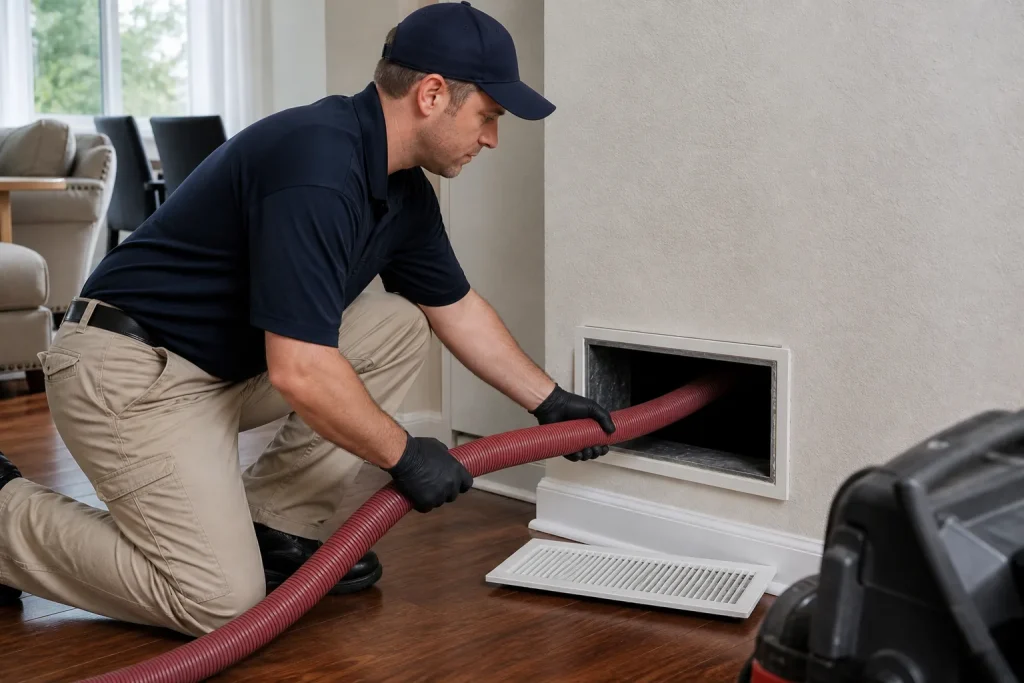
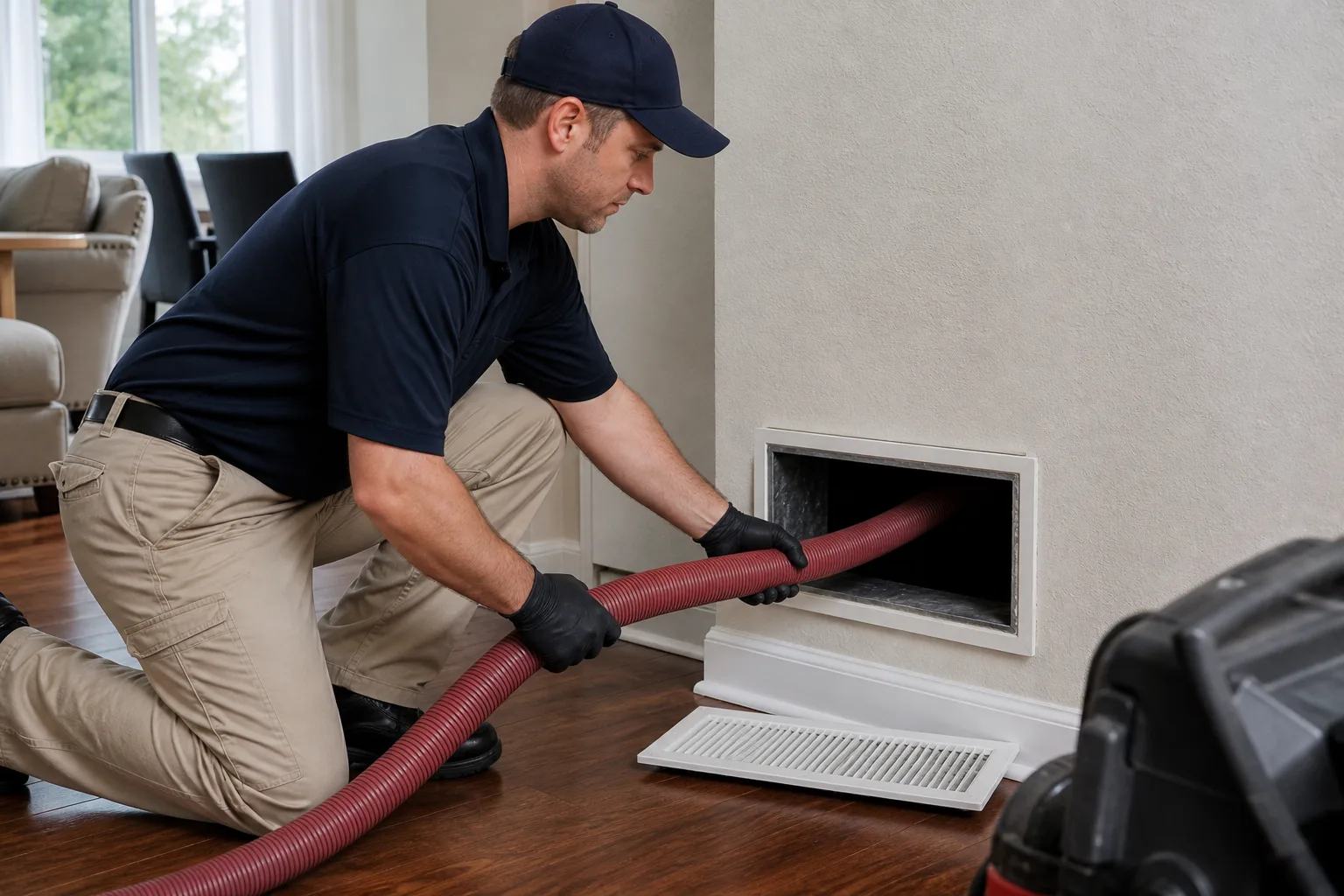
- Negative pressure and containment. A proper job seals the system and pulls debris toward a collection unit so it doesn’t spread into the room. Ask how the system is put under negative pressure and where the debris ends up.
- Brush and agitation type. Contact cleaning requires agitation. Ask whether they run a rotary brush or air-whipping system and whether the tool reaches the full run, not just the register end.
- Camera inspection ability. A camera lets a technician see the inside of a trunk line and confirm the work. If a provider can’t show you inside the duct, you can’t know what was cleaned.
We use Rotobrush and Nikro equipment, which are recognized professional systems rather than consumer-grade tools. That’s a starting point, not a finish line. The right answer to all three questions above is what tells you the job will be thorough in an Energy Corridor home, where duct layouts vary enough that method matters.
What Guardsman’s typical scope covers versus full-system cleaning
A typical franchise duct cleaning usually covers supply and return runs and the registers. That’s a useful baseline. Full-system cleaning goes further, and the gap between the two is where most homeowner complaints start.
Here’s the difference in plain terms:
- Duct runs only: supply and return ducts, registers removed and cleaned, debris vacuumed out. This is the common franchise scope.
- Full-system cleaning: everything above, plus the main trunk lines, the plenum where air leaves the equipment, the evaporator coil area, and any accessible cabinet surfaces. That’s where debris accumulates and where airflow problems often begin.
- Sealing and repair: after cleaning, leaks in the duct system get addressed. Cleaning without sealing can restore airflow that then escapes through gaps. That’s why we offer Duct Repair & Sealing alongside cleaning, which many cleaning-only competitors don’t.
If you’ve only had the runs cleaned, you’ve had a partial job. For a full-system approach, see our Air Duct Cleaning Energy Corridor page, or review what proper HVAC cleaning adds to the equation.
Red flags in a Guardsman or any franchise quote
Most of the warnings you’ll hear about duct cleaning trace back to how a quote was built. A price that doesn’t reflect your actual system is the first sign the scope won’t either. Watch for these in Energy Corridor:
- Flat pricing with no system details. A price quoted before anyone asks how many zones or how much linear duct you have is a guess, not an estimate.
- Teaser pricing. A low headline number that balloons once the technician is inside. We quote one flat price per system, agreed before work starts, so the invoice matches the estimate.
- No written scope. Ask exactly what will be cleaned and what won’t. If it isn’t written down, it isn’t part of the job.
- No way to verify the work. Ask for before-and-after photos of your own system. A provider who can’t produce them can’t prove the work happened.
- Upsell pressure on sanitation. Sanitizing has a place, especially with Abatement Technologies or Guardsman products for contamination control, but it should be a considered recommendation tied to what’s found, not a default add-on.
We’ve seen plenty of quotes from franchise operators that were honest and well-built. The point is to ask, not assume. A provider who welcomes the questions is usually a provider worth hiring.
Energy Corridor duct layouts and why method matters
Energy Corridor homes often sit on slab-on-grade foundations, and many run multi-zone systems to keep rooms comfortable across a wide floor plan. That matters for duct cleaning because slab construction typically means ductwork runs overhead or in soffits rather than through a basement you can see into. When ducts are hidden, method and camera verification matter more, not less.
Multi-zone systems also mean more dampers, more branching, and more places for debris to settle. A technician who treats every system the same will miss those branches. Ask how many zones your system has and whether the quote accounts for each of them. If your system was built for filtration and quality control with brands like Honeywell or Aprilaire, the duct layout and filtration setup should be part of the conversation too, not an afterthought.
Dryer vents deserve a mention here because they’re a separate fire risk and a separate job. If you haven’t had yours done, look at dryer vent cleaning for the safety-first version of that work.
When to call a pro instead of DIY
Duct cleaning isn’t a homeowner project. Consumer vacuums and shop tools don’t create the negative pressure or agitation a real job needs, and reaching the trunk lines or coil area isn’t realistic without professional equipment. It’s also not a health risk to skip in most cases, but it’s a genuine one if you ignore the signs.
Call a professional when you notice:
- Dust settling quickly after cleaning, or visible dust at the registers
- A musty smell when the system kicks on
- Uneven airflow between rooms or zones
- Utility bills climbing without a clear cause
- No record of the ducts ever being cleaned
If any of that sounds familiar, see what proper air duct cleaning involves for an Energy Corridor system, then have a specialist look at it before deciding. An inspection costs nothing and tells you more than a guess.
Related services in Energy Corridor: once your ducts are cleaned and the air is moving, sanitizing with Abatement Technologies or Guardsman products, or Honeywell and Aprilaire filtration upgrades, can help the system stay clean. All of it falls under the five services we offer, so you’re not calling a second contractor for each piece.
The Bottom Line
Franchise duct cleaning lives or dies on the local operator, so ask about equipment, scope, and verification before you book. Red flags are specific: flat-rate pricing that ignores your system, no written scope, no before-and-after photos, and pressure to sanitize as a default. A provider using professional equipment, like Rotobrush and Nikro, and offering camera inspection and repair is a different job than a name-only operator running a surface pass.
If you’re in Energy Corridor and need help, Air Duct Cleaning Energy Corridor offers free estimates. We work from one flat price per system agreed before work starts, and you get before-and-after photos of your own ducts. Call (855) 726-7308.
Frequently Asked Questions
It can be, if the local operator runs professional equipment, provides a written scope, and can show you camera confirmation and before-and-after photos. The brand name alone tells you nothing about the job quality, so ask the same questions of Guardsman that you’d ask of any provider. If you don’t want to vet a franchise operator, call (855) 726-7308 for a free estimate.
Estimates vary with system complexity, number of zones, and duct footage, so price is best set per job by a written estimate. Be wary of a low headline price and a much larger invoice after the technician arrives. We quote one flat price per system before work begins. Call (855) 726-7308 for an exact quote, and estimates are free.
Cheap quotes often cover fewer ducts, skip the plenum and coil area, or use consumer-grade tools with no camera verification. Cheaper pricing also tends to track shorter jobs. Ask what’s actually being cleaned before comparing prices, then demand the scope in writing. Call (855) 726-7308 and we’ll walk you through what a full job includes.
Ask for before-and-after photos of your own ducts and, where possible, camera footage of the interior. A full-system provider can show you the trunk lines, not just the registers. If the provider can’t produce proof, treat that as the answer. Call (855) 726-7308 for a free estimate with verification built in.
Written by the team at Air Duct Cleaning Energy Corridor.
Need Air Duct Cleaning Help?
Call Air Duct Cleaning Energy Corridor - the local pro we connect you with is licensed and insured, here with fast help in Energy Corridor.
(855) 726-7308