
Air Duct Cleaning What It Really Costs: What Energy Corridor Homeowners Pay in 2026
A $99 duct cleaning special and a $950 duct cleaning quote can both be completely honest prices. They’re just for two entirely different scopes of work, and the industry rarely explains which one you actually need. Most price guides are written to justify a low advertised rate rather than to explain what drives legitimate cost variation. That’s the wrong way around. So instead of handing you a single number, we’re going to build a real cost model for an Energy Corridor home: system size, duct material, contamination type, and the add-ons that are sometimes necessary and sometimes just upsold. The goal is to make you price-literate. Once you can read a quote line by line, you’ll know within five minutes whether the company in front of you is being straight with you.
For 2026, air duct cleaning in Energy Corridor typically runs $350 to $700 for a standard single-system home, and $600 to $1,200 for the larger multi-system houses common in this part of Houston. Those are honest whole-system ranges, and the written estimate you receive sets the final price. If you’d rather have a professional assess the system than guess at it yourself, call (855) 726-7308.
Key Takeaways
- Typical energy corridor pricing: $350-$700 for a single-system home, $600-$1,200 for multi-system homes with long duct runs.
- Vents, linear duct footage, duct material, and system age are the four variables that legitimately change price.
- Beware per-vent pricing. A real quote covers the whole system, not a count of registers.
- Sanitizing, dryer vent cleaning, and coil cleaning are legitimate add-ons, but they should be justified by what’s actually in your ducts.
- Energy Corridor humidity and long HVAC runtime mean above-average contamination loads compared to a milder climate.
Why Do Two Quotes for the Same House Differ So Much?
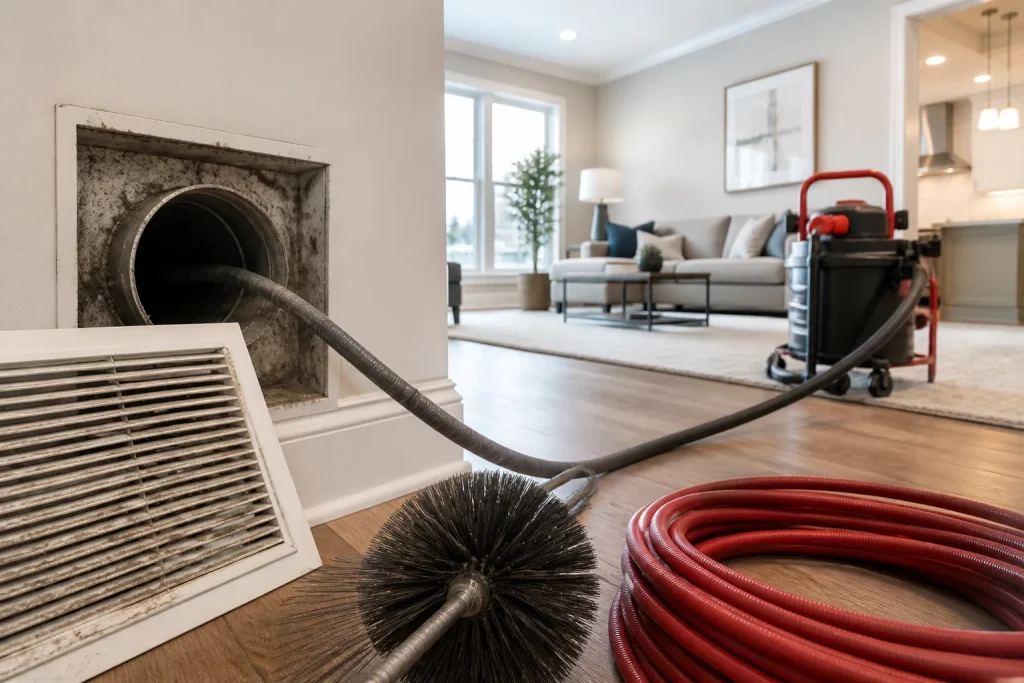
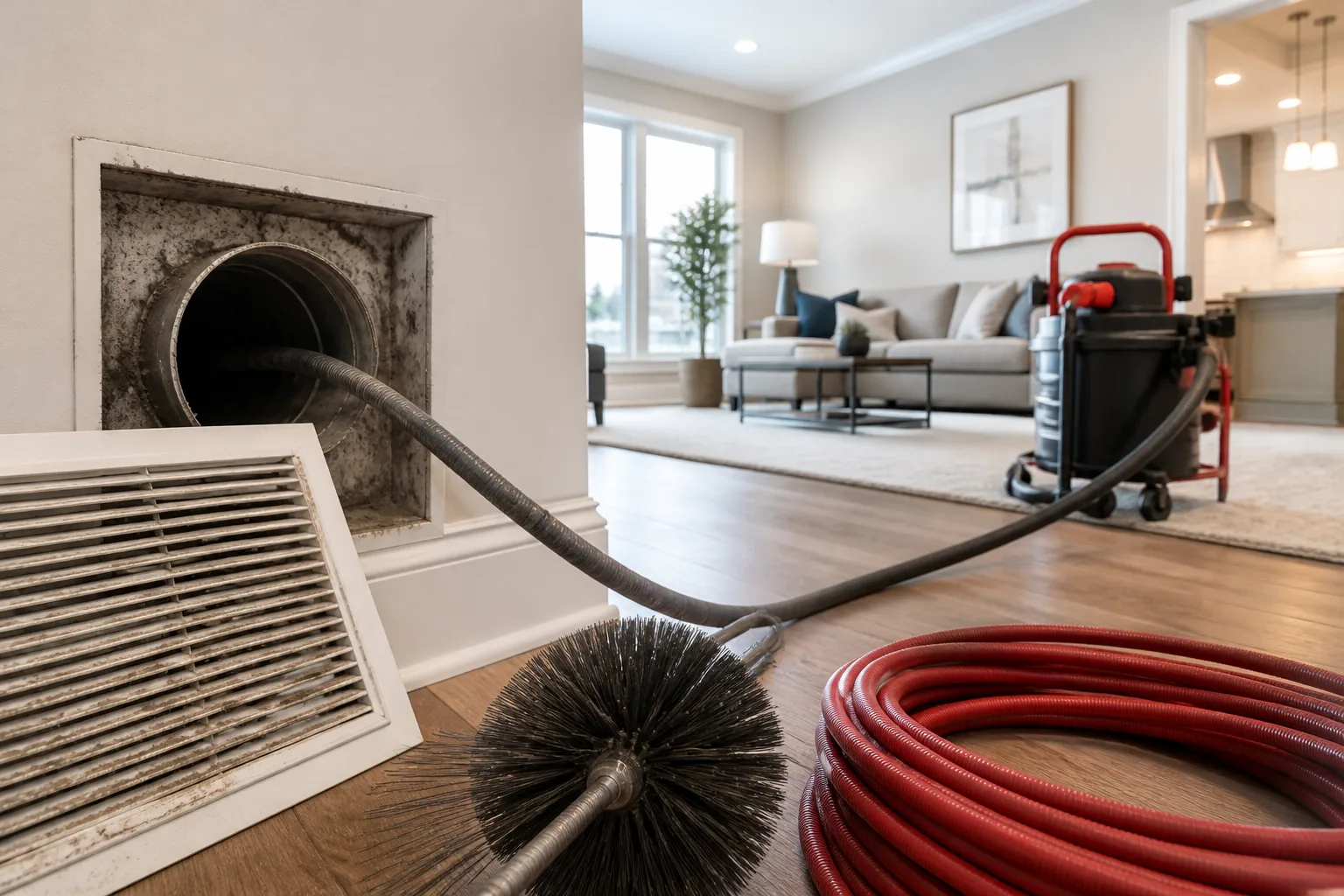
Because they’re almost never for the same job. A low advertised rate usually covers one trunk line and a handful of vents with a shop vacuum and a spinning brush. A full-system clean covers every supply and return run in the house, opens the plenum, cleans the air handler’s blower compartment, and does a before-and-after inspection. Those are different products, and only one of them removes the contamination that’s actually causing the problem. We’ve seen homeowners reject a fair quote because it was triple a competitor’s teaser price, then call back a month later when the dust was still settling on the furniture. Cheap and honest isn’t the same as cheap and complete.
The other variable is equipment. Professional-grade systems like Rotobrush and Nikro use negative pressure and agitation that consumer tools can’t match, and the difference shows up in the price because it costs more to run and takes more time. A quick sweep and a full clean both produce a clean-looking vent cover. Only one of them cleans the run behind it.
What Actually Drives the Price in Energy Corridor?
Four variables do most of the work. Understanding them is the fastest way to read any quote.
- Number of vents and returns. Every supply and return is a run that must be cleaned. A home with forty openings is a different job than one with fifteen.
- Linear footage of duct runs. Long runs, multiple trunks, and complex layouts take more time and more access work. A sprawling ranch-style layout cleans very differently from a stacked two-story.
- Duct material. Flex duct is fast to clean but easy to damage with the wrong tool. Sheet metal is durable and cleans well. Fiberboard duct is the most delicate and the most time-consuming, because aggressive cleaning destroys it and the technician needs to use gentler tools at lower pressure. Expect fiberboard systems to price toward the top of the range.
- System age and condition. An older system has usually accumulated more debris and may have loose joints or disconnected runs that need sealing before cleaning even makes sense. Duct Repair & Sealing is where we find most of the value in a home older than twenty years.
Energy Corridor homes tend to push all four variables toward the higher end. Many houses here are larger and run two HVAC systems, with generous square footage and long duct runs. And because Houston humidity keeps air conditioners running much of the year, those systems log more runtime hours than a home in a drier climate would. More runtime means more air moving through the ducts, which means more dust, more buildup, and faster contamination accumulation. That’s why the “average” national numbers you’ll find online understate what a typical Energy Corridor job actually involves.
| Cost factor | Typical 2026 range | Notes |
|---|---|---|
| Standard whole-home duct cleaning (single system) | $350 – $700 | Includes all supply and return vents, plenum, and blower compartment |
| Multi-system home (two HVAC systems) | $600 – $1,200 | Common in Energy Corridor’s larger homes |
| Sanitizing / mold treatment | $100 – $300 | Justified when there’s visible growth or musty odor |
| Dryer vent cleaning (add-on) | $125 – $225 | Safety-driven, not cosmetic; reduced fire risk |
| HVAC / coil cleaning (add-on) | $150 – $400 | Essential if the coil is fouled with debris |
| Duct repair & sealing | Quoted per job | Fixes the root cause of contamination and air loss |
Those ranges are estimates, and the written estimate is what sets the final price. Call (855) 726-7308 for an exact quote on your system.
Which Add-Ons Are Necessary and Which Are Just Upsells?
Sanitizing is necessary when there’s a real biological problem: visible mold growth, a persistent musty smell, or contamination after water intrusion. It’s an upsell when there’s no evidence of any of those things. If a technician recommends sanitizing without showing you what they found, ask to see it. Sanitizing products like those from Abatement Technologies and Guardsman do what they claim, but there’s no reason to treat a clean system. Similarly, mold treatment should follow a confirmed finding, never a smell alone.
Coil cleaning is trickier, and here’s why it matters: a dirty evaporator coil drives higher energy bills and shorter equipment life, but the coil lives in the air handler, not in the ducts. Cleaning the ducts and leaving a fouled coil is like vacuuming a room and leaving the rug. If your system is older and hasn’t been serviced, add it to the scope. Filtration upgrades using Honeywell or Aprilaire products are another legitimate add-on that pays off in dust reduction between cleanings, though we’d advise against a filter that’s out of spec for your system’s airflow.
Dryer vent cleaning is in its own category because it’s a safety service first. Lint accumulation in the vent line is a real fire hazard, and it’s an inexpensive add-on that should be done on its own schedule regardless of whether you clean the ducts. We treat it that way.
How Do You Read a Quote Line by Line?
A thorough quote names the parts of the system it’s covering, not just a price. If yours doesn’t, ask questions. A well-built quote includes the following, and the absence of any one of them is a signal worth questioning.
- A stated number of supply and return vents, matching what’s actually in your home.
- Access points (each run must be accessed, and access is where labor lives).
- Cleaning of the air handler’s blower compartment and plenum.
- Before-and-after photos of your own ducts so you can verify the work.
- A statement on duct condition, including any loose joints or connections spotted during cleaning.
- Any recommended add-ons, each tied to a specific finding rather than a generic pitch.
A surface clean names only “the vents” with no mention of the trunk lines or the air handler. A thorough one names what’s being cleaned inside the system, then verifies it with photos. That single distinction tells you more than any price ever will.
When to call a pro
DIY covers filter changes and visual dust checks, and we’d encourage both. It doesn’t cover full-system cleaning, and it absolutely doesn’t cover electrical work in the air handler, gas-fired equipment, or any step that requires opening the blower compartment. If your ducts show visible mold, if the system hasn’t been cleaned in years, or if you’re noticing uneven airflow or musty odor, it’s time to bring in a technician. A trained professional diagnoses what’s causing the problem, not just what’s visible. If you’re unsure, call (855) 726-7308 and we’ll talk it through.
Related services in Energy Corridor
Depending on what a quote uncovers, you may need dryer vent cleaning as a safety service, or HVAC cleaning to address the coil and air handler. For a full look at our system-focused approach, see air duct cleaning.
What Does It Cost to Skip the Cleaning?
More than the cleaning itself, in most cases. A dirty system moves less air, which makes the blower work harder and the coil work less efficiently, and that shows up on the utility bill. It also fouls filters faster, so you’re replacing them more often. And it shortens the interval before a costly coil cleaning becomes necessary. The math rarely favors waiting.
The fix isn’t just cleaning the ducts. It’s sealing them, so the system holds air and stays cleaner longer. That’s why we offer Duct Repair & Sealing alongside cleaning. We find what’s causing the problem, not just what’s visible, and then we make sure the system stays clean once it’s clean. Cleaning without sealing lets the leaks re-contaminate everything within months. Cleaning with sealing is the difference between a quick win and a lasting one.
How Often Does Duct Cleaning Really Need Doing?
Every three to five years for most homes, and more often in a climate like Houston’s where the AC runs long hours. If you have pets, recent renovation dust, or a household member with respiratory sensitivity, shorten the interval. If you’ve never had the ducts inspected, have them looked at once. They’ll tell you whether cleaning is even the right next step, and that inspection should come before any cleaning quote.
The Bottom Line
The honest answer to “what does duct cleaning cost in Energy Corridor” comes in two parts. Typical pricing runs $350 to $700 for a standard single-system home and $600 to $1,200 for multi-system homes, with the written estimate setting the final price. The second part is the cost model: the variables that legitimately move the price are vents, linear footage, duct material, and system age, plus whichever add-ons your actual findings justify. Learn those four variables and you can evaluate any quote on its own terms, without needing to trust the person quoting.
If you’re in Energy Corridor and need help, Air Duct Cleaning Energy Corridor offers free estimates – call (855) 726-7308. We answer 24/7. Fast dispatch from 7am to 7pm, Sunday through Friday. Our technicians have up to 15 years of experience and use professional-grade Rotobrush and Nikro equipment, and our five-service scope (duct cleaning, dryer vent, HVAC cleaning, air quality and sanitizing, and duct repair and sealing) means one team handles the whole system. One flat price per system, agreed before work starts, with before-and-after photos of your own ducts. We clean the whole system, then we make sure it stays clean.
Frequently Asked Questions
$350 to $700 for a typical single-system home, and $600 to $1,200 for larger Energy Corridor homes running two HVAC systems. The written estimate sets the final price. Call (855) 726-7308 for an exact quote – estimates are free.
Because they usually cover far less: a handful of vents with consumer-grade tools instead of every duct run and the air handler. A low rate can be legitimate for a smaller scope. The question to ask is what’s included, not what it costs. Call (855) 726-7308 to talk through what your system actually needs.
Ask for before-and-after photos of your own ducts, not stock images. Any thorough job produces them, and looking at the trunk lines in your own home is the only way to verify the work independently. Call (855) 726-7308 to schedule an inspection with photos.
Every three to five years for most homes, more often with pets or recent renovation, and more often in Houston’s climate where the system runs hard. An inspection tells you where you stand. Call (855) 726-7308 – estimates are free.
Written by the team at Air Duct Cleaning Energy Corridor.
Need Air Duct Cleaning Help?
Call Air Duct Cleaning Energy Corridor - the local pro we connect you with is licensed and insured, here with fast help in Energy Corridor.
(855) 726-7308